The situation
Falcon Fire Safety had a product that solves an obvious problem, and no way to sell it.
The device lowers a person from a high floor at a controlled speed when the stairwell is gone. It is certified, it works, and it costs about one and a half lakh rupees. The company was a year old. There was no distributor network, no dealer margin to protect, and no brand anyone had heard of.
The buyer is not a safety professional. It is usually a parent on a high floor who has just seen a fire in the news or in their own building. Sometimes it is a residents' association member or a hotel safety officer buying for a whole building — more informed, more sceptical, and frequently over fifty, reading on a phone at night.
They are being asked to spend more than a month's salary, on a device that will hold a human being over a sixty-metre drop, from a company they have never heard of, with nobody to call.
The problem was never the storefront. It was trust.
There was one more thing that shaped everything. The acquisition channel is a link forwarded into a residential-society WhatsApp group — one resident finds it and sends it to two hundred neighbours. A forwarded link that renders a blank preview card dies there. That single fact settled the technical architecture before any framework was discussed.
What we found
We reviewed the three companies a buyer would find alongside Falcon: Safe Skydrop, the only directly comparable certified device sold in India; KARAM, an established Indian fall-protection manufacturer; and 3M India.
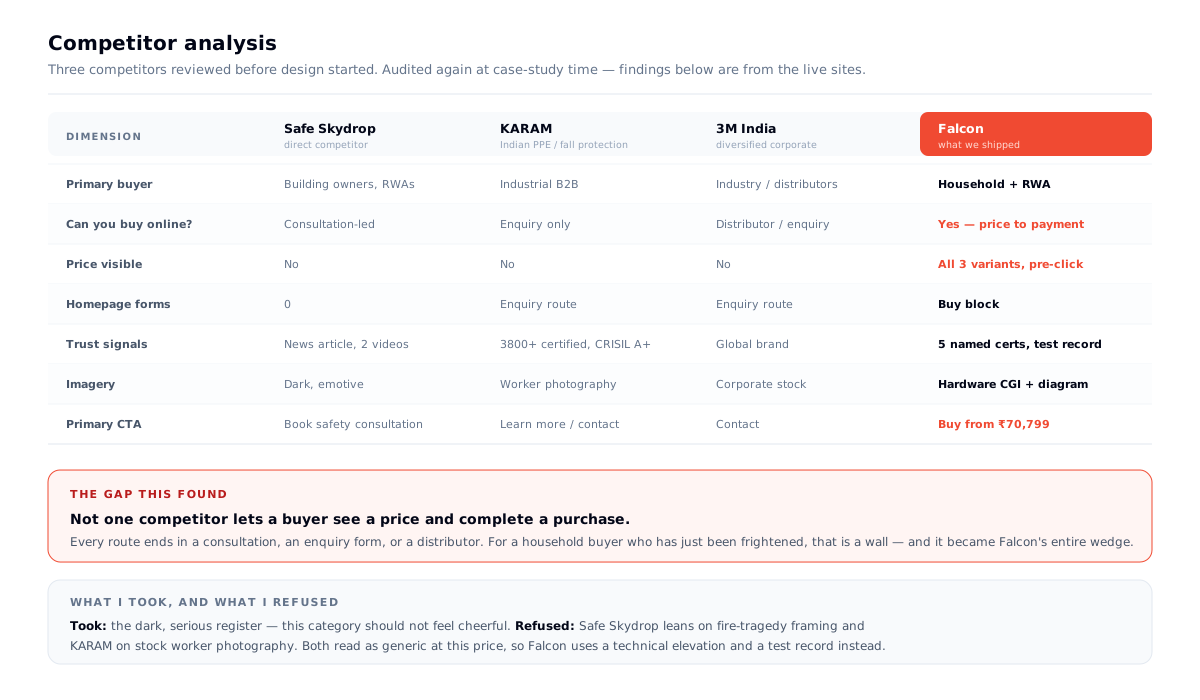
Not one of them lets a buyer see a price and complete a purchase.
Every route ends in a consultation booking, an enquiry form, or a distributor. Safe Skydrop's primary call to action is “Book safety consultation” and its homepage carries no forms at all. KARAM and 3M are enquiry-only business-to-business operations.
For an industrial buyer, that is completely normal. Procurement expects a quote.
For a frightened parent at eleven at night, it is a wall. They have decided to act, and the entire category answers with “someone will call you in two working days.”
That gap was the opportunity, and it turned the project from a website into a real question: can a stranger buy this online, alone, without speaking to anyone?
We took one thing from the competitors — the serious register. This category should not feel cheerful. And we refused two things: Safe Skydrop leans on fire-tragedy imagery, KARAM on stock photographs of workers. At this price point both read as generic. Falcon uses a technical elevation drawing and its own test record instead.
The decision that shaped the build
The brief we were given said “make it feel trustworthy.”
That is not something anyone can build against. It has no test, so it can never be finished and it can never be checked. So we replaced it with a question that could be answered: what does this buyer need to believe, and in what order, before they will pay?
That produced a ranking. Certification first, because in fire safety a missing certificate ends the conversation before anything else matters. Then evidence the product has actually been tested. Then who else has bought one. The page was then built to answer those in that sequence, hardest doubt first.
Ordering it by comfort — brand story, then features, then certification — would have felt better to write and converted worse, because the buyer's biggest doubt would still be sitting unanswered while we talked about ourselves.
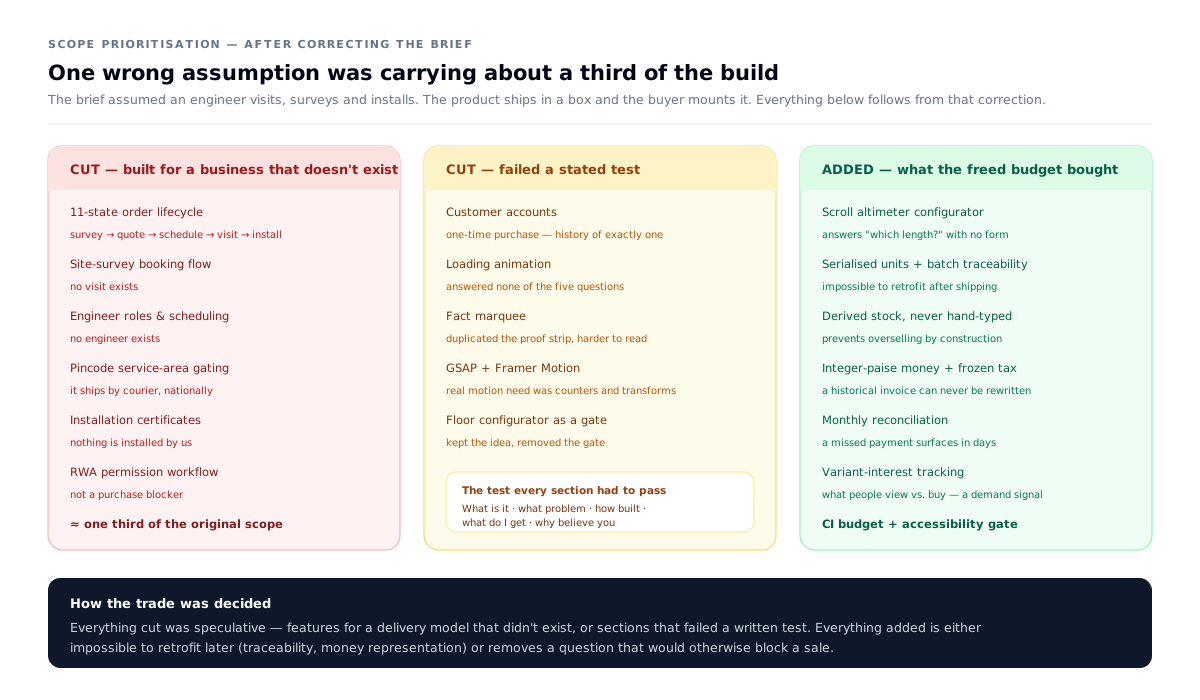
The larger decision was what we removed. Working through the business model before design started, roughly a third of the original scope turned out to be building for a company Falcon was not. Customer accounts, for a product bought once. A dealer network that did not exist. That scope was cut before anyone designed a screen.
Removing a third of a build is not a smaller invoice for us. It is the difference between a system the client uses and a system the client apologises for.
What we built
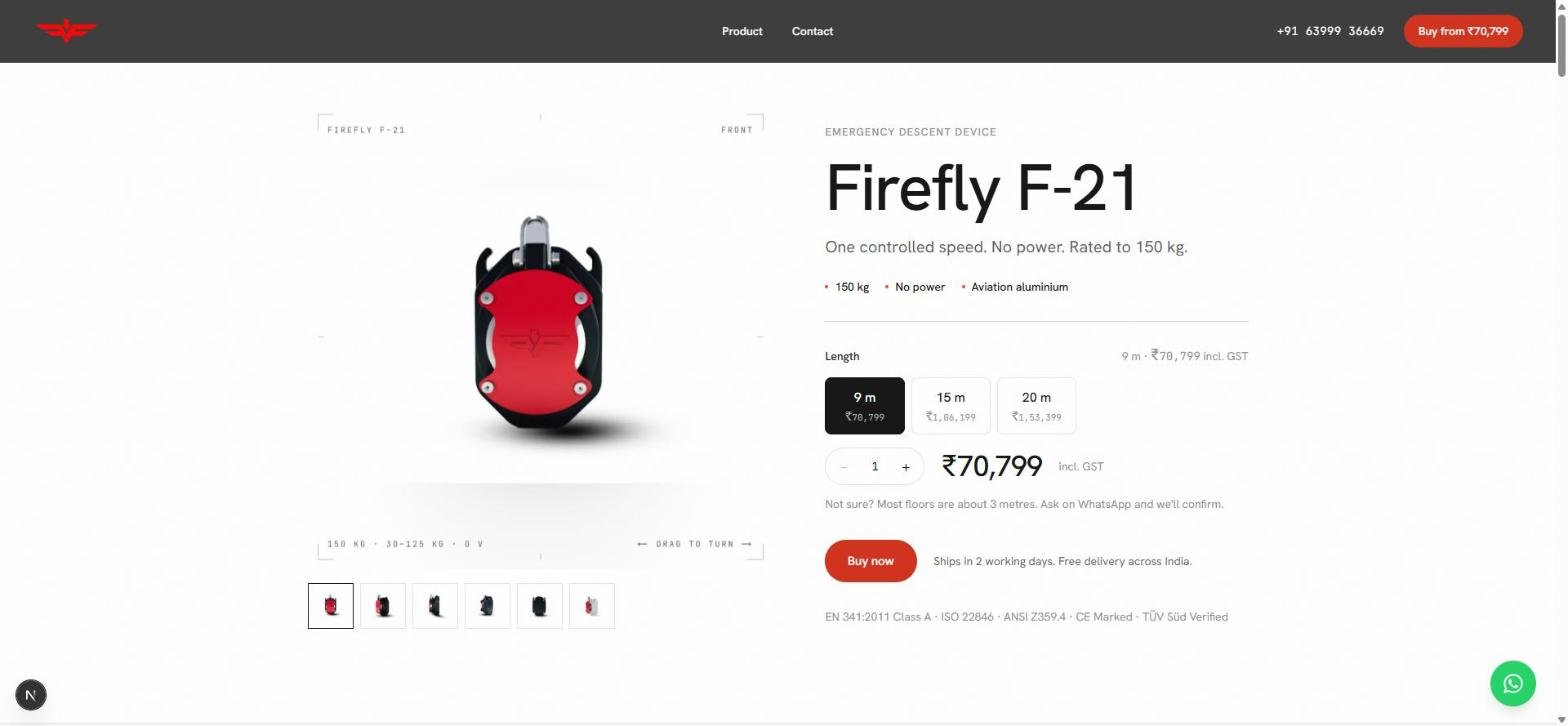
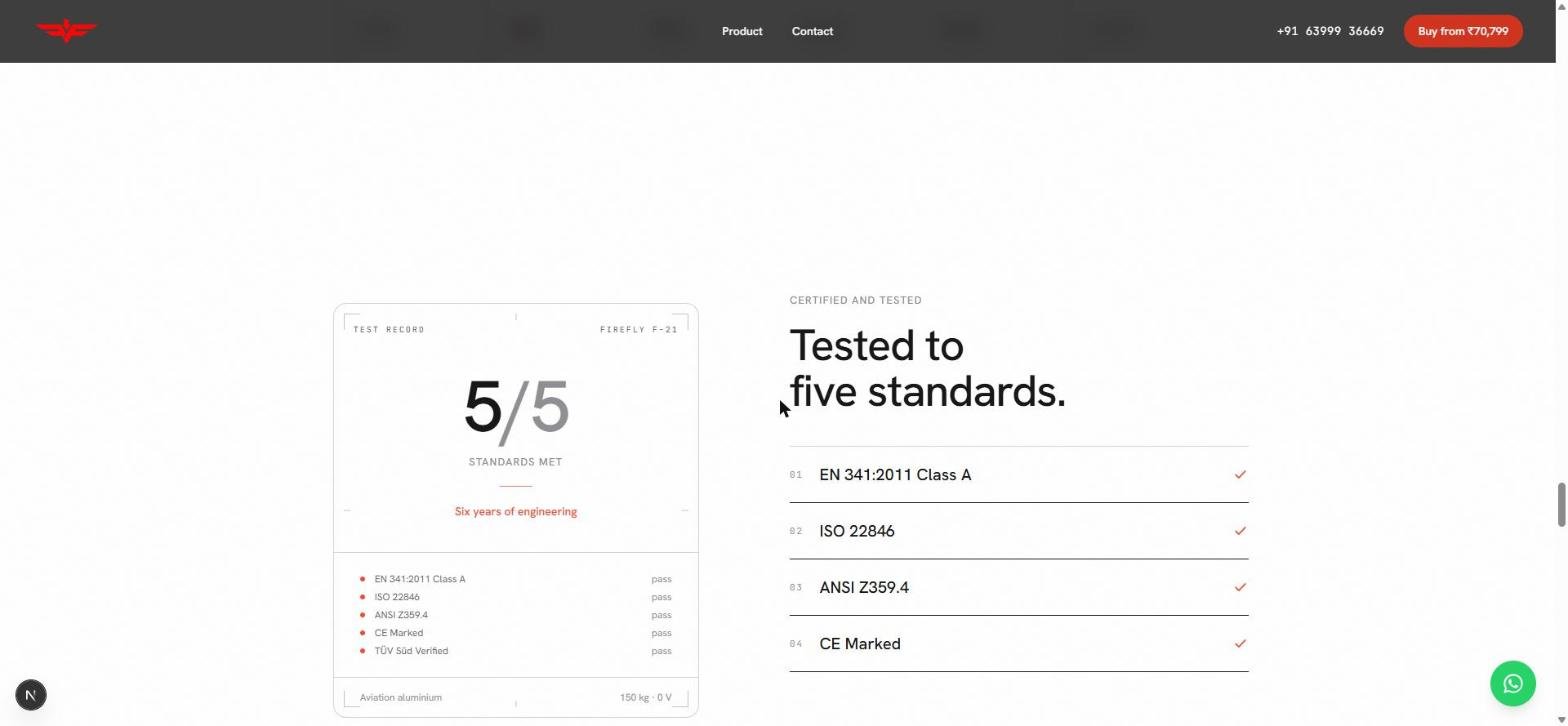
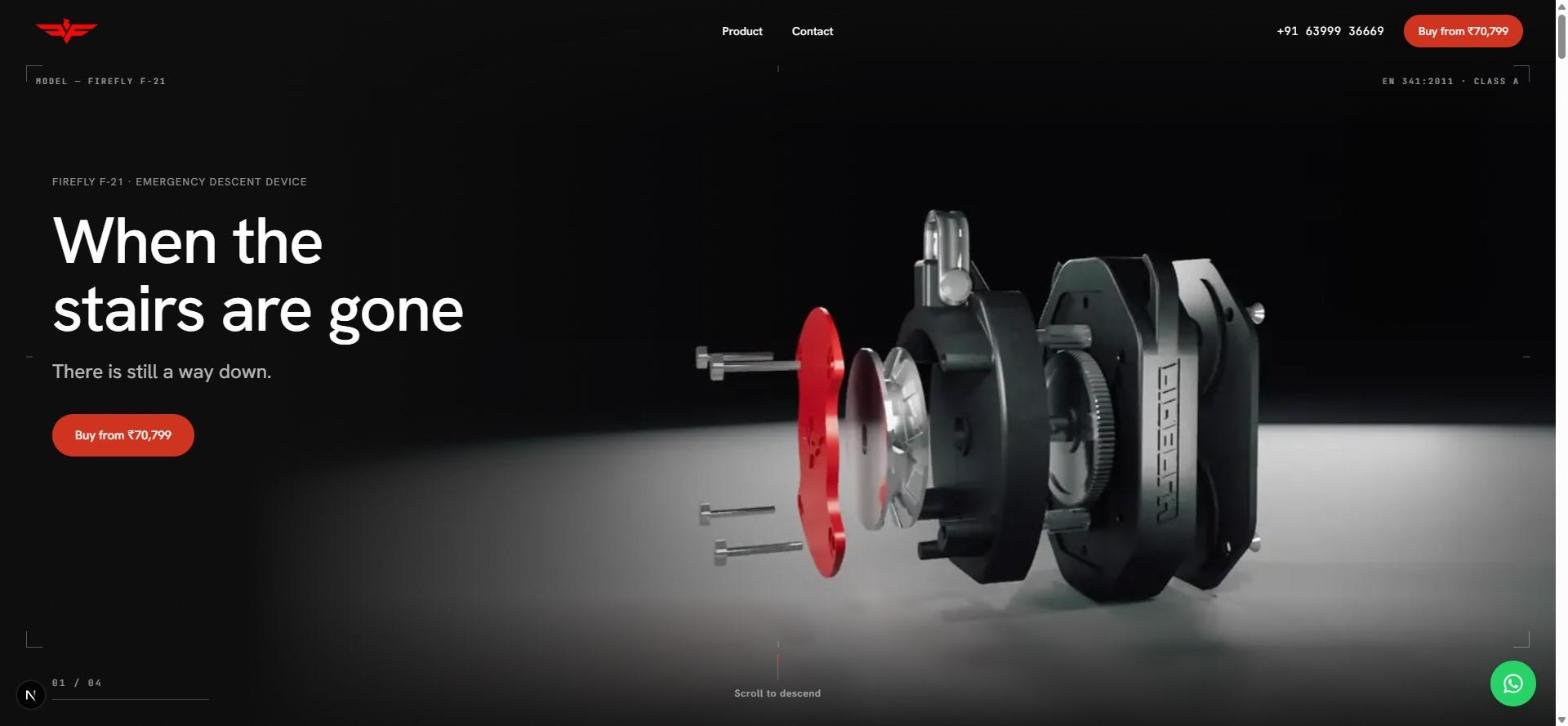
The storefront. One rule governed it: a buyer should never have to scroll to decide. Above the fold sits the product name, the one-line claim, three proof chips, all three length variants with their prices visible at once, quantity, a live total including GST, shipping terms, the certifications, and the buy button.
All three prices show unselected, rather than one price that changes when you click. On a purchase this size, making the buyer work to compare reads as a tactic.
“Ships in 2 working days. Free delivery across India” sits beside the button rather than in a shipping tab, because at the moment of payment there are exactly two unanswered questions — when will it arrive and what else will it cost.
Checkout without an account. For a product bought once in a lifetime, an account would show an order history of exactly one. Removing it removed password resets, session management and an entire interface. Customers track orders with an order ID and a phone number.
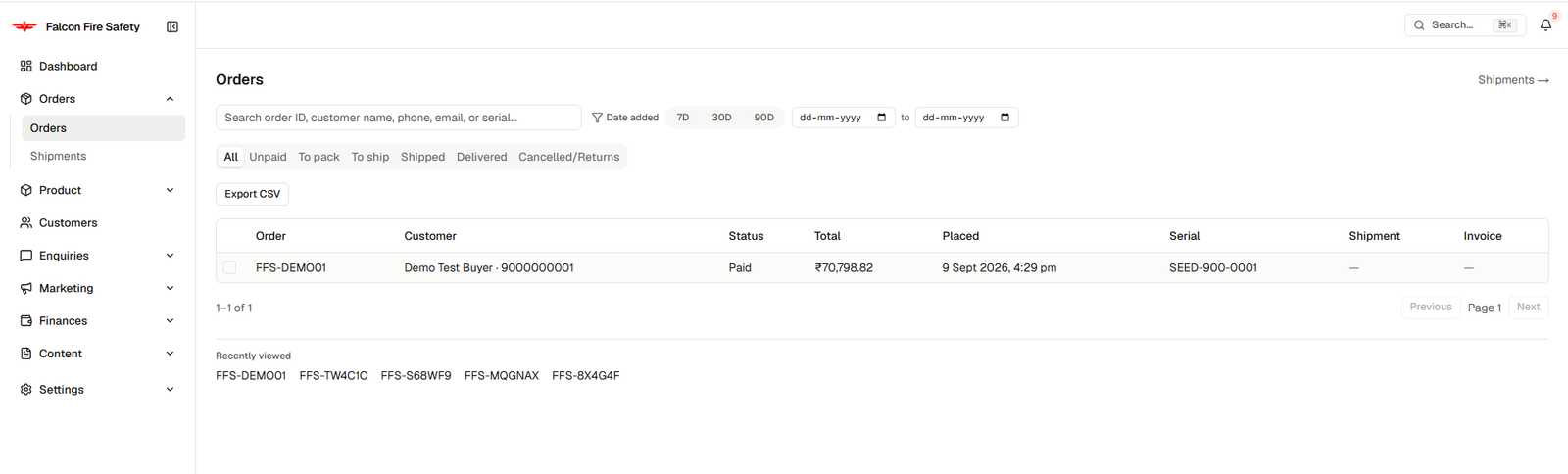
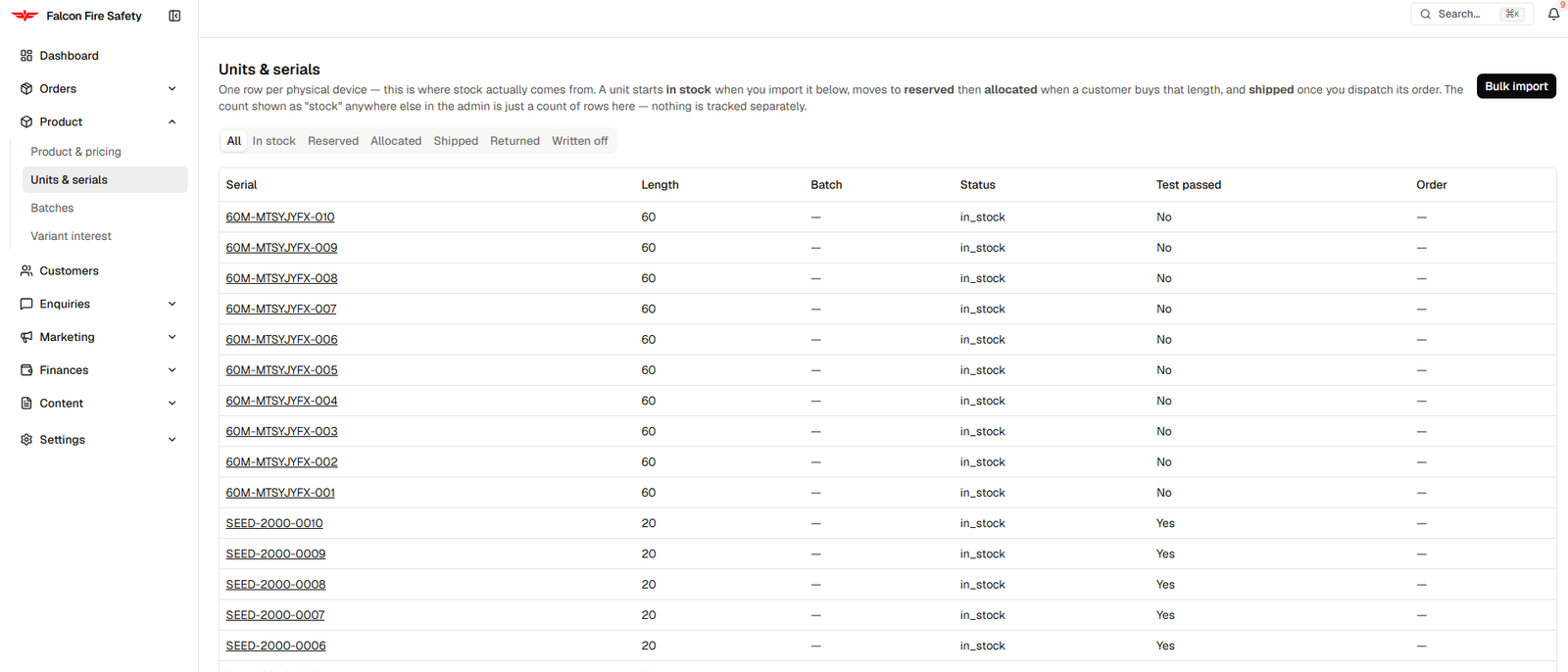
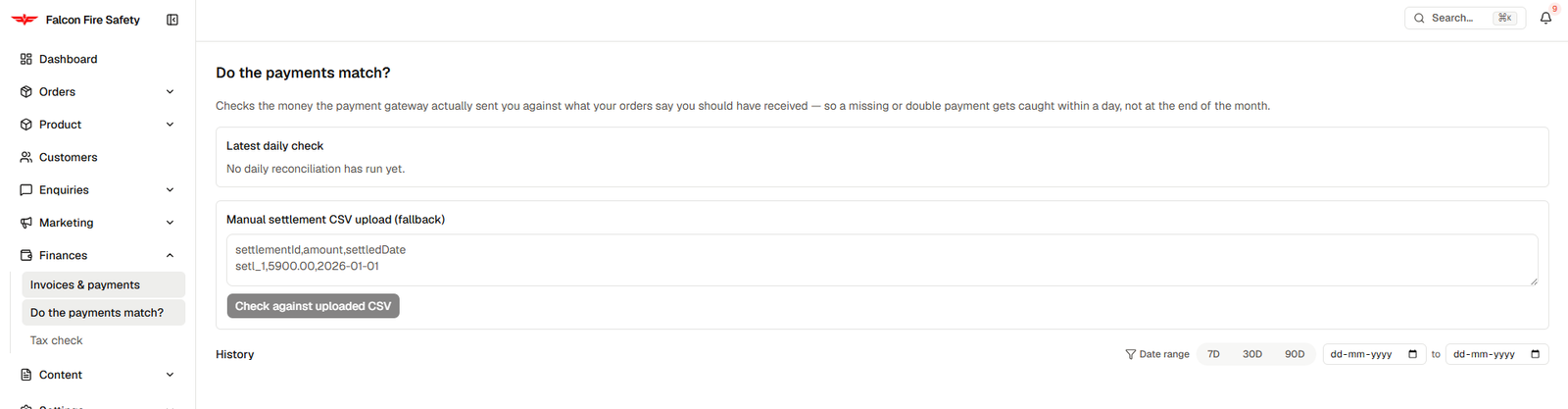
The operations back office, which took more than twice the work of the storefront. Dashboard, orders, customers, enquiries and support tickets, product and pricing, serialised units and batches, shipments, finances with monthly reconciliation, discounts and marketing, content, and settings covering email, payments, shipping, tax, legal metrology, SEO and users.
Enquiries and support tickets are deliberately two separate funnels rather than one inbox. A pre-sale question is a sales opportunity with hours to answer. A post-sale fault report on a life-safety device is urgent. Put them in the same list and the urgent one gets buried under the routine one.
Stock that cannot be oversold. Availability is calculated from unallocated serialised units rather than typed into a field. Two independently maintained numbers for the same fact always drift apart eventually. This prevents the problem by construction rather than by discipline.
Traceability from day one. Every unit is tracked by serial and batch from the beginning, before there was any interface for a recall. Retrofitting traceability onto units that have already shipped is not a software problem — it is phone calls.
Running it without us
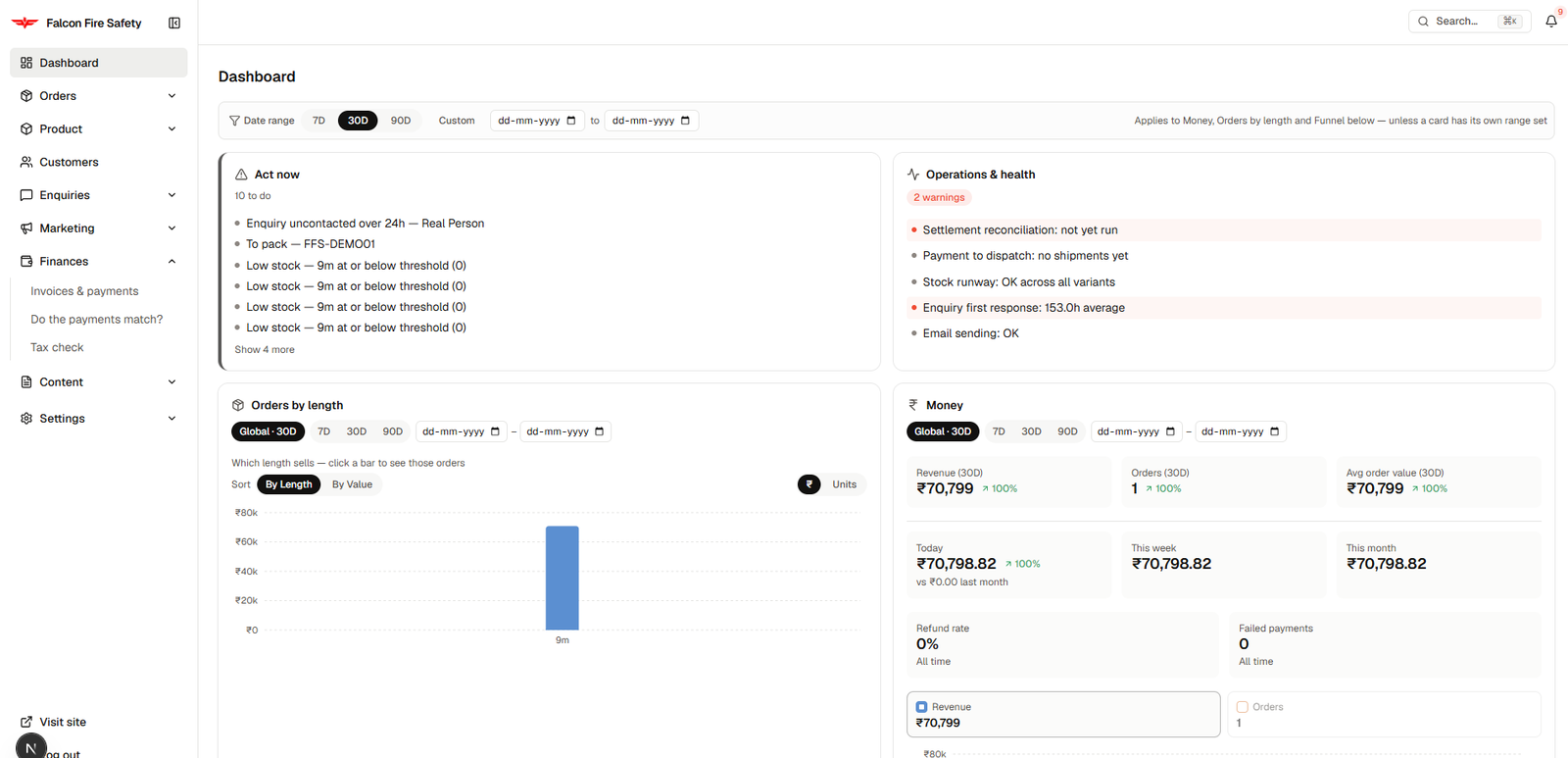
Falcon's owner runs this business alone. Not for a transition period. For years.
So the test every admin screen was designed against was this: on day thirty-one, can the client change a price, a phone number, or a length variant without calling a developer?
That question decided more of the build than any visual choice. It is why money is stored in integer paise and computed server-side, with tax frozen onto the order at the moment of sale — so a later price change can never quietly rewrite what a customer was charged last March. It is why stock is derived rather than entered. It is why there is one credential type in the entire system rather than separate customer and admin identities.
None of that is visible on the storefront. All of it is the difference between a business the owner runs and a business that runs the owner.
The storefront optimises for a four-second first impression. The admin optimises for whether one person can operate this correctly, alone, for years.
“Every other company in our category makes you fill a form and wait. We wanted someone to be able to decide at midnight and act on it, because that is when people think about this. Cluxn pushed back on our brief in the first week — they told us ‘make it feel trustworthy’ could not be built, and asked what a buyer needs to believe instead. That changed the whole project.”
Vashudev Bajaj, Chief Executive Officer, Falcon Fire Safety“The most useful week on this project produced no design at all. We went through the business model and found that about a third of what we had been asked to build was for a company Falcon was not — accounts for a product bought once, a dealer network that did not exist. Cutting that early is worth more to a client than anything we could have designed with the same time.”
Vyomi Singh, Design & Build Lead, Cluxn
What changed for the business
Falcon has not launched yet, so there are no sales figures to report and we are not going to invent any. What exists is what was delivered:
A manufacturer that can sell direct in a category where every competitor routes the buyer to a consultation or a distributor — the gap that made the project worth doing.
About a third of the original scope never built, because the business model was examined before the design was. That is budget the client did not spend and a system they do not have to maintain.
Three systems that behave as one — storefront, operations admin and API — with design tokens generated from a single source so the two interfaces cannot drift apart.
An owner in control of pricing, inventory, tax, content and SEO from day one, without a developer.
Performance and accessibility enforced by the build pipeline, so the site cannot gradually degrade after handover the way most sites do.
The launch plan is written, including the three things we expect to be wrong about and the test tasks designed to surface each one. Registering what you expect to fail, before running it, is the difference between testing something and looking for applause.
If this sounds familiar
If you manufacture something good and your entire sales process still routes through a callback, ask what that costs you at eleven at night — when someone has decided to buy and your website's answer is “we will get back to you.”
And if you are about to commission software, the most valuable week is the one before anyone designs anything: working out which third of the scope is for a business you are not.
Tell us what your customers ask before they buy. If the honest answer is “they call and we explain it again”, that conversation belongs on a page — and we can show you what it would take.