The situation
RSG Profile Manufacturing had a website. That was not the problem.
The problem was where its buyers actually were. A contractor sourcing roofing sheets in Uttar Pradesh does not search for RSG. He searches for roofing sheets — and lands on IndiaMART, on Justdial, on a Google results page where eleven suppliers look interchangeable. He opens three of them on his phone, standing on a site, and gives each about ten minutes.
So RSG's website was never competing with other manufacturer websites. It was competing with a directory listing — a page carrying a phone number, some grainy photographs and a star rating.
That reframes the job entirely. The site did not need to be beautiful. It needed to be more legible and more credible than a directory entry, in under thirty seconds, on a cheap phone, without asking the buyer to change how they buy.
And how they buy is by phone. There is no cart in this category. A quote is a WhatsApp message. Any website that measures itself on transactions is measuring the wrong thing.
What we found
Before designing anything, we reviewed the four suppliers the same buyer would have open in other tabs: Anand Sales, Alviva Steels, Maruti Profile and Supreme PEB.
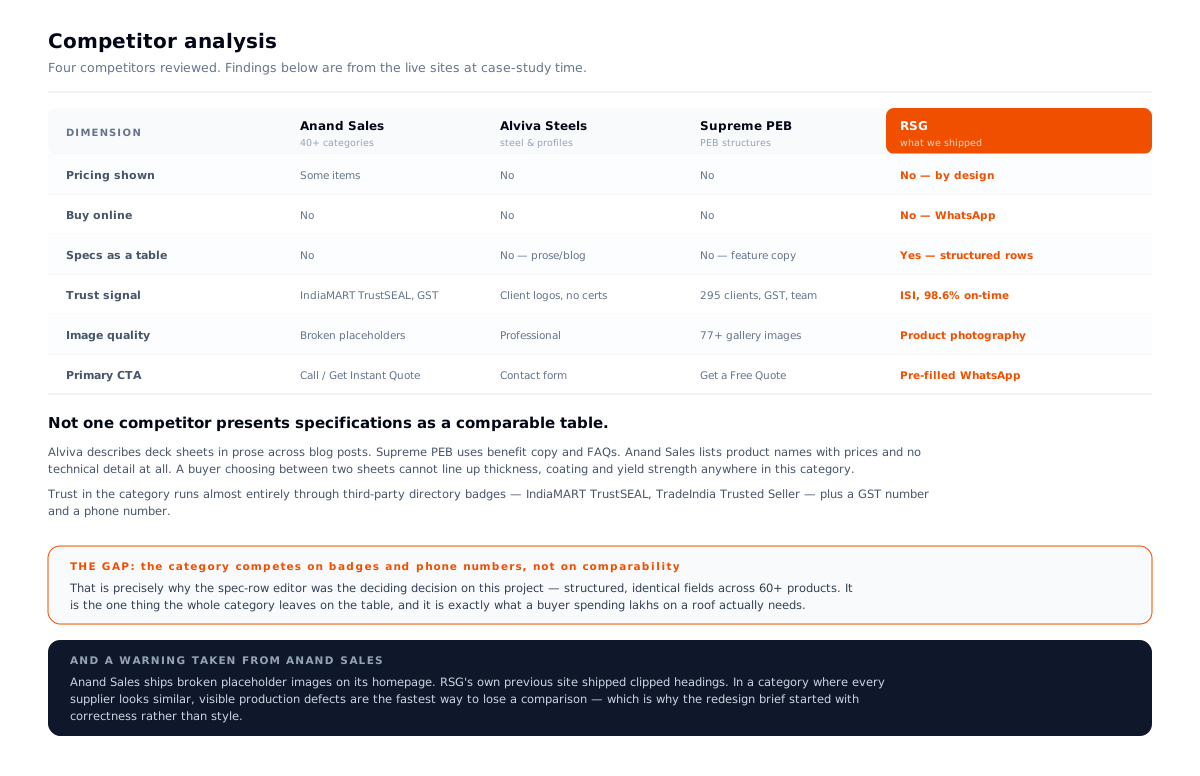
Not one of them presents specifications as a comparable table.
Alviva describes deck sheets in prose spread across blog posts. Supreme PEB uses benefit copy and FAQs. Anand Sales lists product names and prices with no technical detail at all.
A buyer choosing between two steel sheets cannot line up thickness, coating and yield strength anywhere in this category. Which is exactly why he ends up phoning three suppliers to ask — not because he wants to talk to anyone, but because the information does not exist in a form he can compare.
RSG's own sales team confirmed it in a review session. Most incoming calls were not buying signals. They were buyers reading specifications aloud to each other over the phone.
This is not a local quirk. Recent research on Indian MSME procurement found that eight in ten cite wider selection and ease of comparison as the reason they have moved to digital buying channels, and eight in ten expect that to increase over the next two years. The category had simply not caught up with its own buyers.
There was a second finding, and a warning inside it. Trust in this category runs on third-party badges — IndiaMART TrustSEAL, TradeIndia Trusted Seller — plus a GST number and a phone number. That is borrowed credibility, and every competitor has equal access to it. Meanwhile Anand Sales was shipping broken placeholder images on its homepage, and RSG's own previous site was clipping headings.
In a category where every supplier looks alike, a visible defect is the fastest way to lose a comparison. So the build started with correctness, before style.
The decision that shaped the build
Everything followed from one call: make the catalogue comparable, and spend nothing on anything else.
That meant specifications could not be typed into a text box. They had to be structured fields — thickness, coating, grade, dimensions — stored separately and rendered identically across more than sixty products, so a buyer comparing two sheets sees the same rows in the same order every time.
It also decided the platform. RSG's previous site ran on WordPress, and the deciding factor was not speed or preference — it was the spec editor. Getting structured, repeatable, comparable fields out of a standard WordPress editor means custom post types, plus a builder plugin, plus template overrides: more bespoke work than building it properly, on top of a plugin surface the client would then have to keep patched for years.
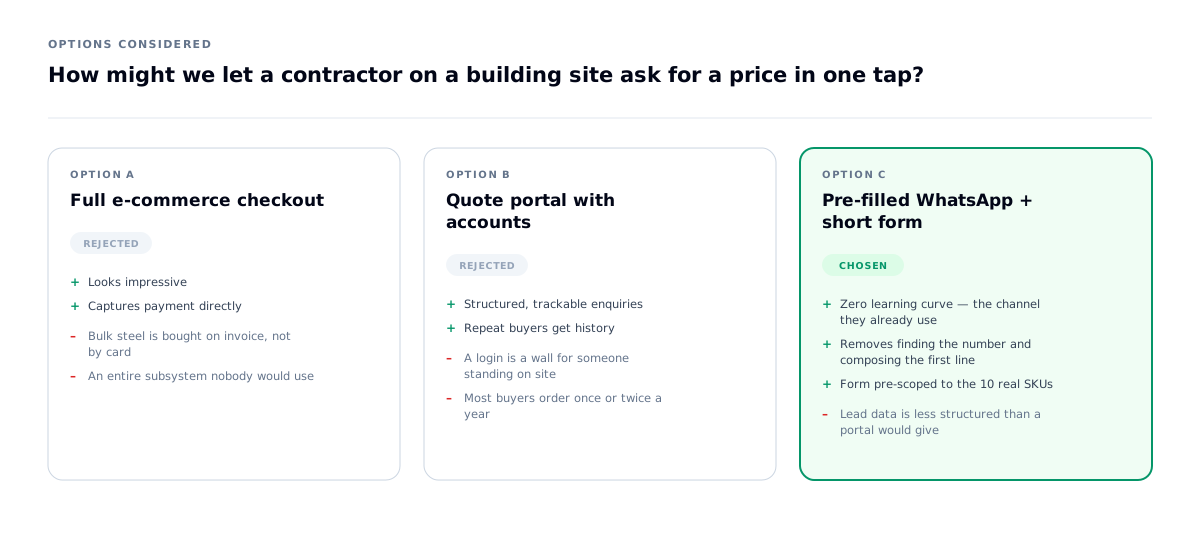
And here is what we chose not to build: no cart, no accounts, no payments.
The sale happens on WhatsApp and by invoice. A checkout would have added an entire subsystem nobody would use, consumed a third of the timeline, and given the owner a dashboard full of zeroes. That time went into specifications, proof and failure states instead.
We would rather remove scope than deliver something that looks impressive in a demo and sits unused for three years. Most of the value in this project came from what we declined to build.
What we built
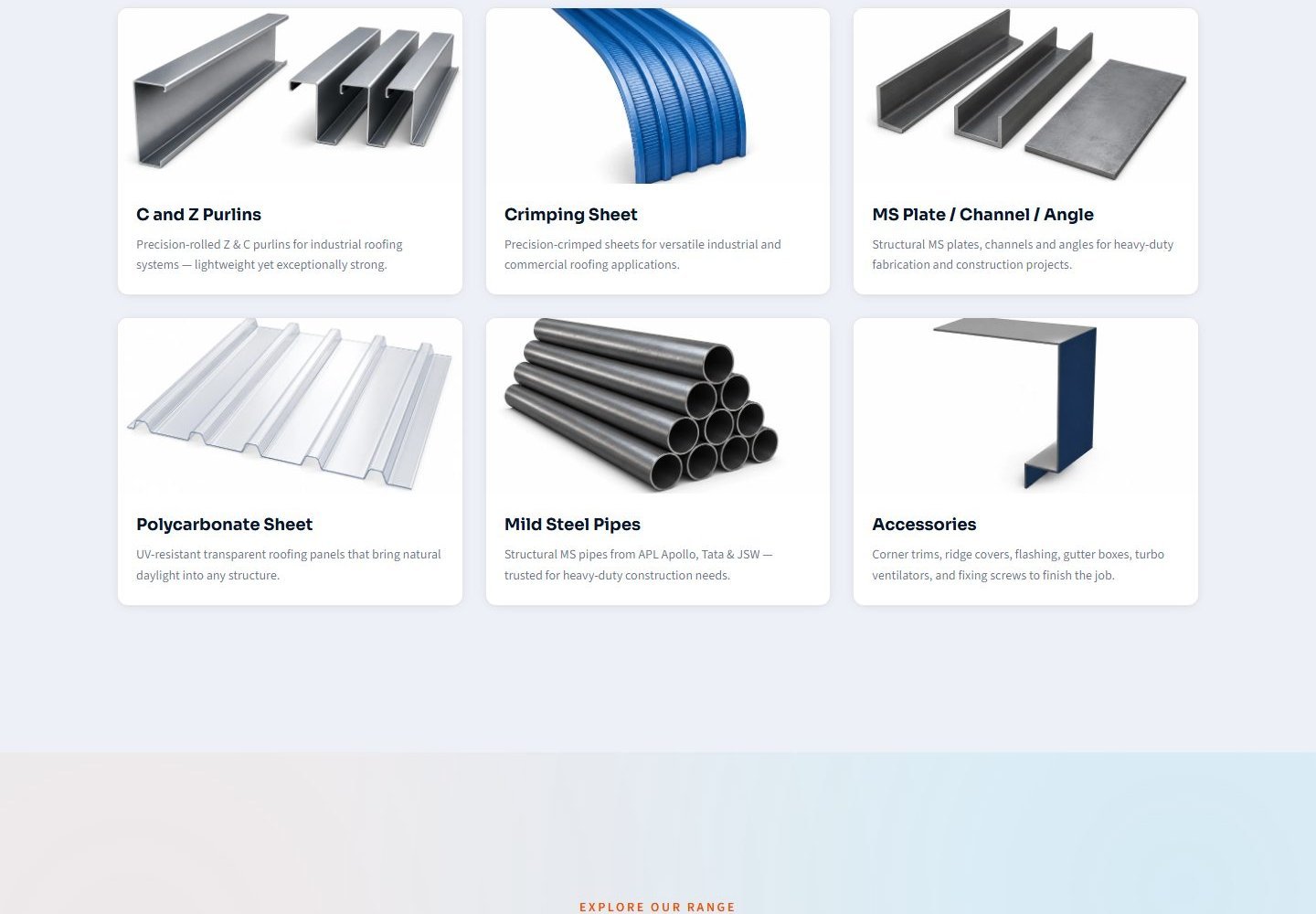
The catalogue. Ten product categories, sixty-plus products, each with a structured specification block that renders identically everywhere. A buyer can open two products and compare them line for line without translating between formats.
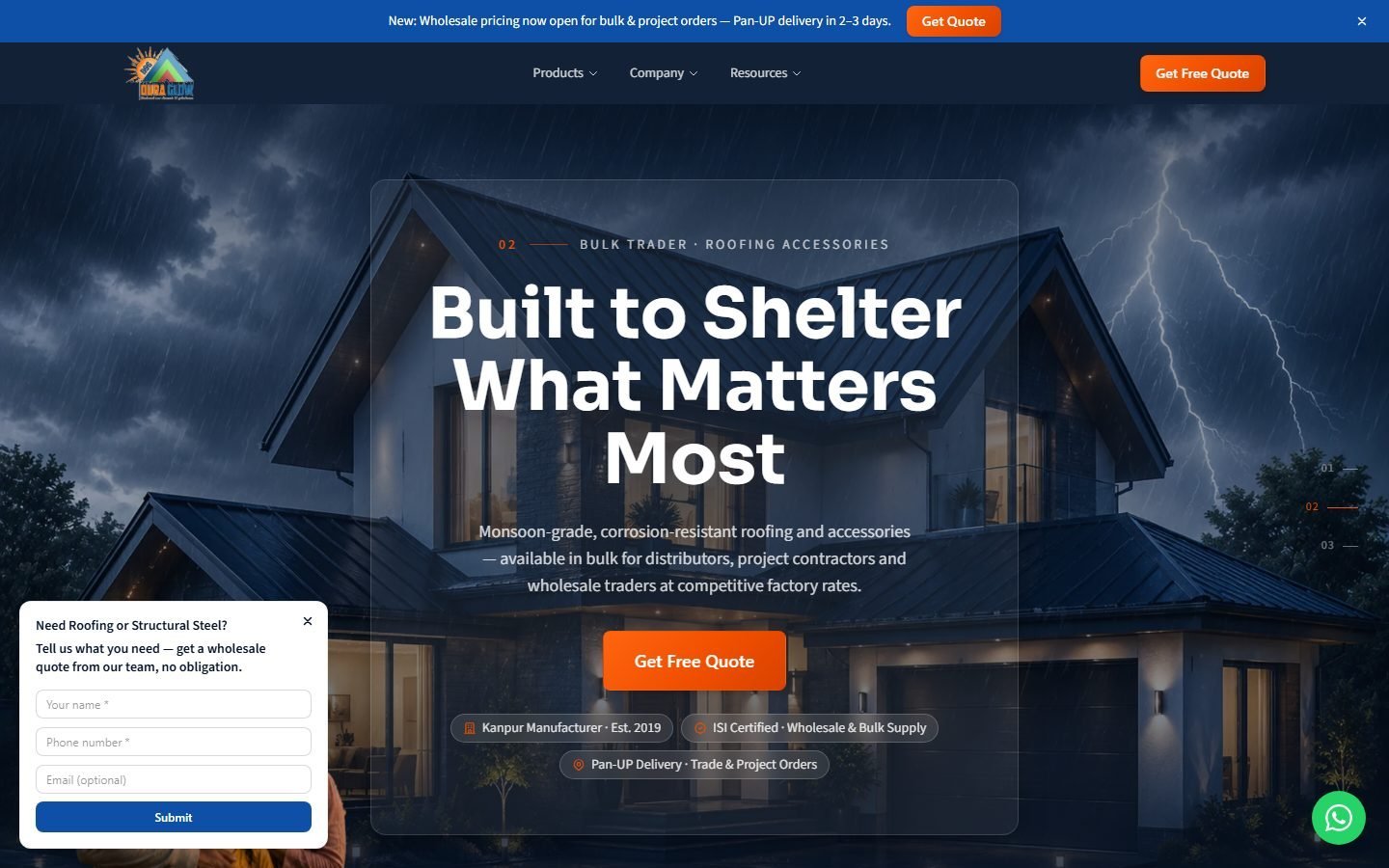
The homepage, which serves three different buyers. The same catalogue sells to a homeowner re-roofing a house, a contractor buying in bulk, and an industrial buyer specifying decking for a warehouse. The site cannot know which one arrived, so the hero rotates across all three rather than guessing and alienating the other two.
Enquiry capture that survives failure. Every form carries source attribution, so RSG knows which category and which channel produced a lead. Spam handling is invisible to the buyer. And every failure path falls back to WhatsApp — because on patchy site data, a form that silently fails is a customer lost with nobody ever knowing.
A living style guide. Four colours, two typefaces, every component visible on one screen during development. Not a public page — a working tool, so the eleventh component still matches the first.
The admin. Products, specifications, prices, blog, events, testimonials and contact details, all editable by the owner.
Running it without us
The question every manufacturing owner actually wants answered is not what will you build? It is what happens when you leave?
Most of them have been here before: a website that was fine at handover, then went stale because every change meant an email to a developer who took four days and charged for it. Within a year the phone number is wrong and the product list is out of date.
So the test we designed the admin against was simple: on day thirty-one, can the client change a specification, a price, or a phone number without calling anyone?
They can. Product specifications are structured fields in a form, not code. Content is editable. Contact details are settings. RSG's catalogue has grown since handover without a single line of our involvement, which is the outcome we were aiming at.
A site that only its builder can update is not an asset. It is a subscription.
From the CEO's Desk
“Buyers used to call us to read specifications down the phone. Half those calls were not people wanting to buy — they were people trying to compare us against two other suppliers and not being able to. Now the numbers are on the page in the same place for every product, and the calls we get are further along.”
Mr. Shivam Gupta, Chief Executive Officer, RSG Profile Manufacturing
“The temptation on a project like this is to build a shop. It would have demoed well and it would have sat unused, because nobody in this category buys steel through a checkout. We spent that time making sixty product specifications comparable instead. The measure of the job was whether a contractor standing on a site could choose RSG without ringing anyone.”
Vyomi Singh, Design & Build Lead, Cluxn
What changed for the business
RSG is now the only supplier in its comparison set whose specifications can be compared. When a buyer opens three tabs, two of them require a phone call to answer a basic technical question and one does not. That is the whole strategy, and it holds on a mid-range phone on slow data.
Enquiries arrive with context. RSG can see which product category and which channel produced each one, instead of guessing where its business comes from.
The catalogue is the owner's. New products and revised specifications go live the day they change.
And nothing is visibly broken — which sounds trivial until you remember that a competitor in the same comparison set is still shipping placeholder images on its homepage, and that buyers in this category read a defect as a warning about the product.
We are deliberately not publishing an enquiry-volume percentage here. The honest position is that RSG's enquiries were never instrumented before the rebuild, so any before-and-after number would be invented. What can be verified is what the site does that its competitors' sites cannot.
If this sounds familiar
If your buyers find you on IndiaMART rather than by name, and your specifications live in a PDF nobody opens, you are being compared right now against suppliers whose numbers are just as hard to read as yours.
The opening is that none of you have made it easy. The first one who does stops being a phone call and starts being a shortlist.
That is a six-week problem, not a six-month one — and it usually costs less than the checkout system nobody needed.
Tell us what your buyers ask you on the phone. If the answer is “the same three questions every time”, those questions belong on a page, and we can show you what that looks like for your catalogue.